

Chapter 7 - The Awakening Begins
The Sound Under Water

Chapter Seven
The Shape in the Water
When Tanya first heard the river speak, she thought it was a machine.
Not vocal. Words. Not words. Nothing so simple.
It was a note inside the flood. A thin, bright pressure ran through the roar of water and concrete, too high to be heard right, too precise to be missed. It made her teeth hurt. It made the tiny bones of her inner ear feel like tuning forks. It made the old chain link fence hum under her hand.
She had no right to be there.
That much was obvious and had been obvious for at least twenty minutes.
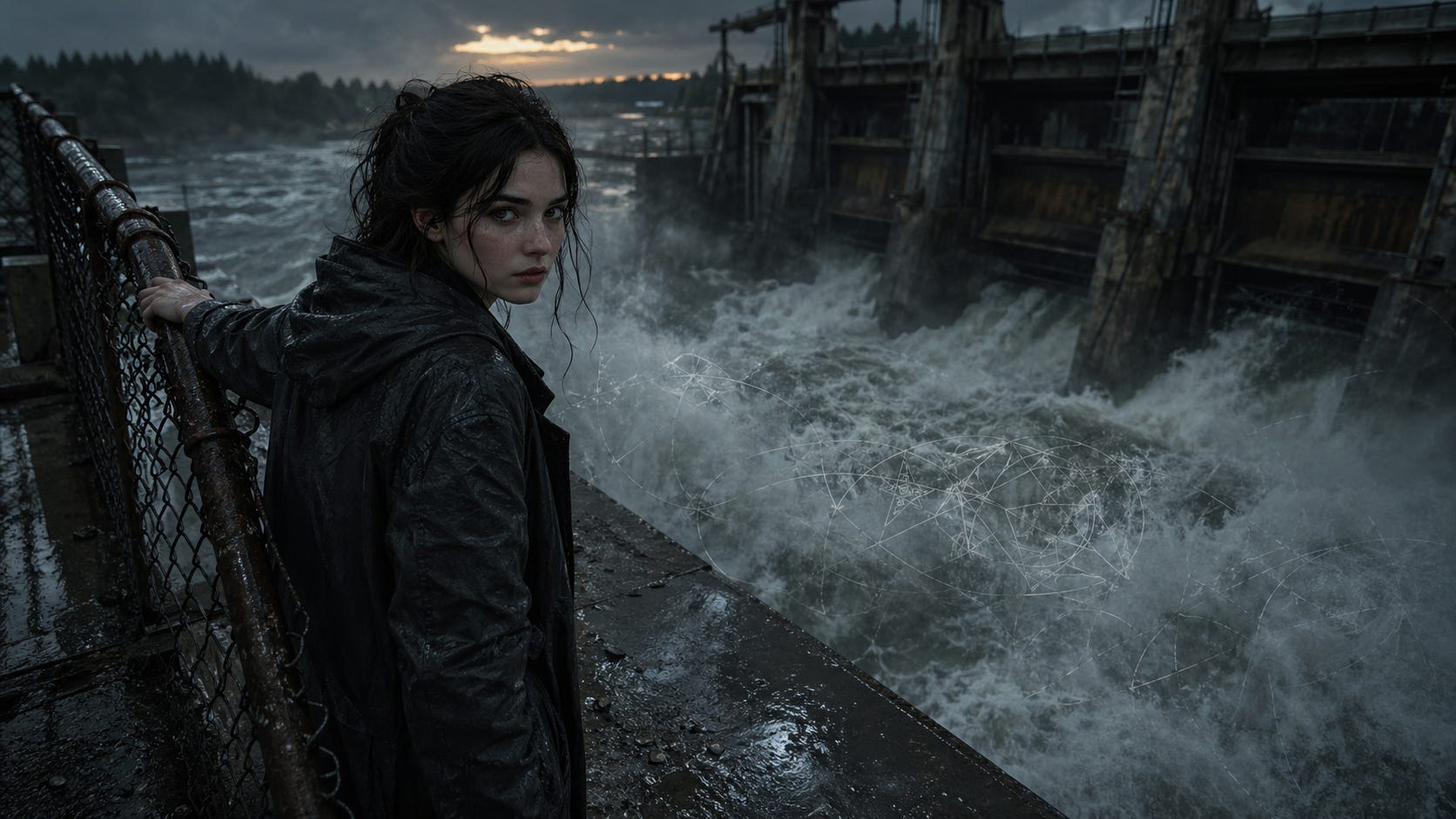
The spillway below her was in full spate, swollen by three days of rain in the hills. Water came down from the dark like something escaping a wound, struck the broken lip of the abandoned hydro channel, and exploded into white force. It battered the concrete walls, recoiled, folded over itself, and plunged onwards between rusted sluice gates into the blackened throat of the river gorge.
No one used the old hydro works anymore. The council had fenced it, signed it, inspected it poorly and left it to the weather, graffiti, moss and teenagers with more nerve than judgement.
It wasn’t nerves that kept Tanya away.
She was there for the sound of it.
It had begun after dinner, in the rain, faintly. And a silver thread of tone, on the border of hearing. She had blamed the heating pipes, at first. Then the old refrigerator Then the transformer box at the end of the road. By nine she’d taken apart the desk lamp, shut down her laptop, unplugged three chargers, and stood absolutely still in the middle of her room while Aunt Margaret watched from the doorway with the look of a woman wondering if patience was still the moral high road.
“What are you up to?” “Margaret had asked.
Listening.
“What?” “To what?
And that’s the trouble.
Margaret crossed her arms. You got school tomorrow.”
“I know the institution.”
“And an English essay due.”
“I’m aware of the threat.”
“Tanya.”
The single word had contained fatigue, affection, warning, and the hard edge Margaret used when affection had failed to achieve anything useful.
One word that had spoken of fatigue, of love, of warning, and of the sharp edge Margaret saved for when love didn’t get anywhere useful.d in its old bones. Somewhere inside the wall, a pipe It sounded as if it was from the west.
And beneath it all, impossible and distant, the note continued.
Tanya had gone motionless.The rain tapped on the window. The old bones of the house creaked. Somewhere inside the wall a pipe clicked tiredly.west.
Off the river.
From the dark fold in the hills beyond the old road.
“Do you hear that?” Tanya asked.
“And an English essay to write.”
“Tanya., her face changed.
Only slightly. A tightening around the eyes. A loss of colour so brief, Tanya might have missed it if she had not spent most of her life reading adults for concealed danger.
“I know the danger .”ar rain.”
“You paused.”
“I am fifty-eight years old. I pause before most things now.”
“That isn’t an answer.”
“It is the only one I have.”
This was one of Margaret’s tricks: to make truth sound like refusal and refusal sound like truth.
She was not really Tanya’s aunt. She was her father’s cousin, technically, but after the crash the grown-ups had made a set of decisions Tanya had not been invited to attend. “Aunt Margaret” had appeared in official letters, school forms, bereavement arrangements, medical files, and eventually the mouth of every adult who wanted the situation simplified. Tanya had refused the title for nearly a year. Then she had used it once in a meeting with social services because Margaret looked so exhausted that even anger seemed vulgar.
Since then, she has used it rarely.
It still had power when she did.
Margaret Ahearn was spare, practical, sharp-eyed, and impossible to sentimentalise. She wore wool cardigans in colours best described as weather-adjacent. She cooked as if nutrition were an engineering problem. She had taken in a twelve-year-old girl who did not want saving; had defended her from relatives who wanted opinions without responsibility; and had learnt very quickly that Tanya responded better to evidence than comfort.
This did not make them easy with each other.
It made them possible.
“You’re doing it again,” Margaret said.
“What?”
“Leaving the room while standing in it.”
“I’m thinking.”
“You’re disappearing.”
Tanya looked at her.
That was unfair.
It was also accurate.
The note inside the rain sharpened.
For an instant, she saw, not with her eyes but with some inner pressure of recognition, white stone under sunlight, water rising in columns instead of falling, a street of pale steps, and two women standing at a gate.
Then it was gone.
Tanya gripped the back of her chair.
Margaret stepped forward. “What is it?”
“Nothing.”
“Tanya.”
“I said nothing.”
“You went white.”
“I am frequently pale. It’s one of my major hobbies.”
Margaret did not smile.
That was when Tanya knew she had seen something in her face.
Something familiar.
The knowledge dropped coldly into her stomach.
“You have heard it before,” Tanya said.
Margaret’s expression closed.
“I did not say that.”
“No. You very carefully didn’t say that.”
“You are tired.”
“I’m not.”
“You are always tired when you start seeing patterns in things.”
Tanya felt heat rise into her face. “That is a cheap thing to say.”
Margaret’s mouth tightened.
For a second, she looked older than she usually allowed herself to look.
“Yes,” she said. “It was.”
The apology was real, and therefore inconvenient.
Tanya turned away first.
“I’m going to bed.”
“Good.”
“I’m not sleeping.”
“I suspected that.”
“Then don’t pretend this is working.”
Margaret sighed.
The hallway behind her was dark and narrow, and lined with old photographs that Tanya avoided unless she wanted to ruin her day. They’d put too many of them in her parents. Her mother, laughing, in a green scarf, on a beach. Her father, holding a mug and looking out of the picture. Both of them young in a permanent, insulting way of the dead.
“Tanya,” Margaret whispered.
Tanya hated that tone even more than the sharp one.
“Huh?”
“If you are ever scared to tell me something, tell me badly. Tell me in the incorrect words. Tell me as a joke, if you must. But tell me.”
The note rose in the rain.
Tanya nearly did.
I keep seeing a city.’ She almost said. I first noticed it when someone said Macroom. I think Mum saw it too but I don’t know how I know that. Something’s happening on the river And I think it knows my name.
Instead, she said, “If I develop a taste for confession, you’ll be first on the list.”
Margaret looked at her for a long moment.
Then she nodded once and left.
Which was why, forty-three minutes later, Tanya climbed out of her bedroom window.
It was not one of her better plans.
The drainpipe was wet. The roof slates were slick. The apple tree below her window had been pruned by someone with optimism but no ladder safety training. By the time she reached the ground, the sleeve of her coat was torn, her palm was scraped, and she had confirmed that spy novels understated the indignity of leaving houses secretly.
The garden was full of rain.
It ticked from the leaves, whispered through the grass, and streamed from the guttering in narrow ropes. The lane beyond the back wall lay black and shining. No lights showed in neighbouring houses except the blue flicker of a television in Mrs Callan’s sitting room. The whole town seemed underwater already, sunk beneath weather and sleep.
Tanya pulled up her hood and headed west.
She knew the back route to the spillway because she knew most routes adults preferred teenagers not to use. Past the allotments. Through the gap in the hedge by the old pumping station. Across the service road where nettles slapped wetly against her jeans. Then into the belt of trees that followed the river down to the abandoned works.
The sound grew stronger with every step.
It was not simply louder. It had structure. Layers. The broad animal roar of floodwater. The hollow percussion of the current striking concrete. The hiss of rain on leaves. The rattle of loose metal somewhere in the dark. Beneath them, that fine bright note, holding steady as if the whole valley were a badly tuned instrument and someone had found the one frequency at which it could be made to remember.
Remember what?
The question came in a voice not quite her own.
She stopped under the trees.
The path ahead dipped towards the old platform above the spillway. Yellow council signs gleamed in the rain: DANGER - FLOOD CHANNEL, NO ENTRY, UNSTABLE STRUCTURE. The fence behind them leaned inward, and someone had cut a gap low enough to crawl through.
Naturally.
The river beyond was invisible except where it caught the cloudlight and tore it to pieces.
Tanya should have turned back.
She knew this with perfect clarity.
She thought of Margaret asleep in the old house, or not asleep, perhaps standing at Tanya’s bedroom door and discovering absence. She thought of the school, the essay, the efficient dreariness of tomorrow morning. She thought of her parents’ photograph in the hallway. She thought of the word that had sat inside her since childhood like a buried coal.
Macroom.
When she was eleven, three months after the funeral, Margaret had taken her to a family history centre in Cork. The trip had been presented as wholesome distraction. Something to connect Tanya to roots, which adults seemed to think were medicinal if administered at the correct dosage. The woman behind the counter had been kind, bored, and damp around the cuffs from the rain. She had opened a folder, traced a line with one finger, and said, “There’s a Macroom branch here, on your mother’s side.”
Tanya had dropped the paper cup of tea she was holding.
For one impossible second, the office vanished.
She was running barefoot over sun-warm stone. Someone was laughing ahead of her. The air smelled of salt, flowers, and lightning. White towers climbed above terraces of water. Bridges hung between them as fine as ribs. The sky held two moons, one bright and one faint as a thumbprint under silk. She knew where she was going. She knew she was late. She knew the women at the lower gate would tease her and let her through.
Then the tea hit the floor.
The woman apologised, though she had done nothing. Margaret took Tanya outside and asked too many questions in too calm a voice. Tanya answered none of them.
After that, Macroom became a private injury.
She researched it at night. Maps. Parish records. Local histories. Folklore archives. Tourist sites with cheerful photographs of bridges and ruined castles. Nothing explained what had happened. Nothing justified the grief of recognition. Eventually she stopped looking, because stopping was the only way not to become ridiculous.
But the word had never gone quiet.
Now the river was making the same place inside her ache.
Tanya ducked through the cut fence.
The platform above the spillway had once held monitoring equipment or control boxes, though little remained except concrete plinths and rusted bolts. Water hammered below, swollen high enough that spray blew across the platform in cold gusts. The chain-link barrier along the edge trembled continuously under the force of the flood.
She moved closer.
The note intensified.
It was inside the water, but not made by the water. That was absurd, yet precise. Like hearing a violin string vibrating inside a collapsing building.
At the broken lip of the channel, where the flood struck and curled back on itself, white cavities opened and vanished. Not bubbles exactly. Voids. Tiny collapses. A violent lace of absence. Tanya watched, fascinated despite the cold, as the river seemed to chew holes in itself and instantly seal them.
Cavitation.
She knew the word from her father.
He had explained it once with a saucepan, a spoon, and unnecessary enthusiasm. Pressure dropping, vapour cavities forming, bubbles collapsing with enough force to damage metal. She had been eight. He had let her listen to a pump through a screwdriver handle pressed to her ear. “Water isn’t soft,” he had said. “It just negotiates before it destroys you.”
Her father had been good at making the world more dangerous and more interesting in the same sentence.
The note in the flood became almost painful.
Tanya gripped the fence.
“No,” she said aloud, though she did not know to whom.
Then the water changed.
It did not rise. It did not glow. It did not perform any of the theatrical gestures by which impossible things help ordinary minds identify them. Instead, in the spray above the collapsing current, fine silver lines appeared.
At first she thought it was reflected light. Then lightning. Then some filament caught in the fence. But the lines held their position against wind and water. They crossed, curved, parted, and returned to each other with a delicacy entirely unlike accident.
A shape was forming.
Not a picture.
A relation.
A central line, slightly curved. Two arms rising around it, not enclosing but protecting or remembering. A branching at the top like antlers, rivers, roots, or decisions. A small closed form near the base.
The shape was wrong and right in the same instant.
Tanya knew it.
She knew it with her skin, with the backs of her knees, with the old grief under her ribs, with some pre-verbal inheritance that did not care whether she consented. The glyph stood in the spray, silver and impossibly thin, and recognition passed through her so violently that her eyes filled with tears.
Cleopolis.
The word arrived without sound.
She staggered back.
Her boot found moss instead of concrete.
For one suspended second she was not falling and not safe. Her heel slid. Her hand tore along the chain-link. The flood opened below her, white and black, all teeth and gravity. She grabbed at the fence, caught metal, lost it, caught again. Pain ripped across her palm. The platform vanished from under one foot.
The note inside the water became a scream.
Then something pulled.
Not her arm. Not the fence.
Something in the air.
The silver glyph twisted.
The spray struck her face like thrown needles.
Tanya slammed against the barrier, half over it, one knee wedged through the lower rail, both hands locked in wire. For a moment she hung there, staring straight down into the flood.
In the depths between the white crashes of water, the darkness opened.
She saw the city again.
Not as memory this time.
As distance.
White terraces rose above an inland sea. Bridges crossed air. Gardens trailed luminous roots into mist. At the lower gate stood two women. One lifted her hand, not in greeting but in warning. The other held something narrow and pale.
A key?
No.
A shape where a key should have been.
The woman’s mouth moved.
Tanya heard no words, but understood one instruction.
Not yet.
Then the vision broke.
She was on the platform, crawling backwards, sobbing breathlessly and swearing without elegance. Her palms were bleeding. Her left knee burned. Her coat was soaked. The flood roared on as if bored by her survival.
The silver lines in the spray had vanished.
Only the note remained.
Fainter now.
Receding.
Or waiting.
Tanya stayed on the concrete until she could stand.
She did not pray. She did not thank anyone. Gratitude would imply an arrangement she did not yet understand. Instead, she inspected her hands, pressed her sleeve to the worst scrape, and laughed once, sharply, because the alternative was hysteria and she had standards.
Then she looked back at the water.
“Not yet,” she said.
The flood gave no answer.
By the time she reached home, the eastern sky had begun to pale behind the cloud.
Getting back in through the window proved harder than getting out, which Tanya felt was narratively unfair. She managed it by climbing the apple tree, stepping onto the lower roof, nearly slipping twice, and entering her room with the grace of a burglar in a documentary about poor decisions.
Her room was cold.
The old study-turned-bedroom smelled faintly of dust, paper, and rain-damp wool. Books lined two walls: mathematics, mythology, computing, medieval history, hydrodynamics, botany, Celtic languages, cryptography, and a shelf of fantasy novels she pretended to keep ironically. The large desk under the window had belonged to her father. It was scarred with compass points, ink stains, and one small burn mark from an experiment he had refused to describe.
Above it hung her map of Ireland.
Macroom was circled in pencil.
She had done that years ago, then covered it with a postcard, then uncovered it, then pretended the whole cycle had no psychological significance.
Now the circled name seemed to look back at her.
She peeled off her wet coat, wrapped her bleeding hand in tissues, and opened a notebook.
For a minute she could not draw.
Her fingers shook too badly.
When she closed her eyes, the glyph stood in the spray again. Not symmetrical. Not decorative. It had the tension of a living thing held still for too long. Every line meant relation. Every curve implied movement. The small form at the base was not an ornament but a seed, eye, wound, or memory.
She tried once.
Wrong.
Again.
Worse.
Again.
Closer.
By the seventh attempt, something in her chest loosened. The pencil moved with more confidence than her mind allowed. The central line curved. The arms rose around it. The branching top leaned slightly left. The small closed form at the base tilted like an eye half-asleep.
The page seemed to deepen.
Tanya stopped.
Nothing happened.
No glow. No sound. No opening in the floor.
Good, she thought.
Then, beneath the drawing, without deciding to write it, she printed one word.
Cleopolis
The room went very still.
Not silent. The rain continued. A car passed distantly on the wet road. The house settled with one of its habitual groans.
But the stillness beneath those sounds was different.
Attentive.
Tanya put down the pencil.
“No,” she said. “Absolutely not.”
The house did not argue.
She almost wished it had.
She took the notebook, crossed the room, and hid it under a stack of physics papers. Then she changed into dry clothes, cleaned her hands properly in the bathroom, and discovered that the scrape across her palm had made an ugly red ladder of cuts but nothing deep enough for stitches. The knee was bruised. The shoulder would complain later. Her dignity had died at the fence and would not be mourned.
In the hallway, she paused by the photograph.
Her parents stood on a windy beach, sun in their faces. Her mother’s hair had blown across her mouth. Her father was laughing at something Tanya no longer remembered. The picture had been taken in the last summer before everything acquired a before and after.
Tanya rarely spoke to it.
Speech to the dead seemed both theatrical and inadequate.
Tonight - morning, almost - she stood before the photograph and felt the old anger rise. Not the simple anger of being left. Something sharper. The suspicion that they had known more than they had told her. That they had walked towards something and failed to come back. That grief, which had seemed like an ending, might have been a locked door.
“What did you do?” she whispered.
The photograph remained sunlit and useless.
Behind her, a floorboard creaked.
Tanya turned.
Margaret stood at the end of the hall in her dressing gown.
For a terrible second neither moved.
Margaret looked at Tanya’s damp hair, the bandaged hand, the mud on her jeans, the scratches on her cheek. Her face did not change dramatically. That was not Margaret’s way. But something in her eyes went flat with fear.
“Were you at the river?” she asked.
Tanya considered lying.
She was good at lying when the lie had architecture. This one would not. There was mud on the floor. Her coat dripped in her room. Her hand was wrapped like evidence.
“Yes.”
Margaret closed her eyes.
Only for a moment.
When she opened them, she did not shout. That would have been easier.
“Kitchen,” she said.
“I’m tired.”
“Kitchen.”
The word had iron in it.
Tanya went.
The kitchen was the warmest room in the house and therefore the one Margaret trusted least. It had old quarry tiles, a battered pine table, blue cupboards repainted too many times, and a window looking over the back garden. Margaret filled the kettle, took out the first-aid box, and moved with such controlled precision that Tanya began to feel worse than she would have if Margaret had simply raged.
“Sit.”
Tanya sat.
Margaret unwrapped the tissues from her hand.
The cuts had started bleeding again.
Margaret cleaned them in silence. Antiseptic stung. Tanya flinched once, then refused to do so again.
“You could have died,” Margaret said.
“Yes.”
“That is all?”
“I agree with the assessment.”
Margaret looked up.
There were sleepless shadows under her eyes.
“You think intelligence protects you from consequences.”
“No. I think consequences are poorly distributed.”
“This is not cleverness.”
“I know.”
“Do you?”
Tanya looked at the table.
The wood grain formed lines like rivers on a map.
“I heard something.”
Margaret’s hand stopped.
There it was again. The tiny interruption. The almost-hidden recognition.
“What did you hear?”
“A note. In the water. It started here. Or I noticed it here. It was coming from the spillway.”
Margaret resumed bandaging, too carefully.
“Floodwater makes strange sounds.”
“Not like this.”
“You were tired. Upset.”
“I wasn’t upset until I almost fell into a river.”
“Do not make jokes.”
“I’m not sure what else to do.”
Margaret finished the bandage and let go of her hand.
For a moment she seemed to be deciding between several possible futures and disliking all of them.
“What did you see?” she asked.
The question was too precise.
Tanya went cold.
“I didn’t say I saw anything.”
“No.”
“But you asked.”
Margaret stood and turned away to pour boiling water into the teapot.
The kettle steamed between them.
“I am asking now.”
Tanya watched her back.
There was a history in that back. In the squared shoulders. In the refusal to tremble. Margaret knew something. Not enough, perhaps. But more than rain, more than school, more than ordinary anxiety about reckless teenagers.
Tanya could tell the truth.
Tell it badly, Margaret had said.
In the wrong words.
As a joke if you must.
“I saw a shape in the spray,” Tanya said.
Margaret set the kettle down.
“A shape.”
“Lines. Silver. Like a symbol. Or a diagram.”
Margaret did not turn around.
Tanya continued, because stopping had become worse than speaking.
“And I saw the city again.”
The sentence entered the kitchen and changed it.
Rain tapped at the window. Somewhere in the walls, the old pipes clicked. Margaret’s hand rested on the counter beside the teapot. Her knuckles had gone pale.
“What city?” she asked.
Too quietly.
Tanya’s anger returned, sudden and grateful.
“You know.”
“No.”
“You do. Or you know enough to be frightened.”
Margaret turned then.
Her face had the severe stillness of someone holding a door shut from the other side.
“I know that your mother had dreams,” she said.
Tanya stopped breathing.
“What dreams?”
“Fragments. She did not tell me everything.”
“What dreams?”
Margaret’s mouth tightened.
“She spoke of white buildings. Water. Women at a gate. A place she could not enter.”
Tanya stood so quickly the chair scraped the tiles.
“You knew?”
“I knew she had dreams.”
“And you never told me?”
“You were a child.”
“I was the child in them, wasn’t I?”
Margaret flinched.
That was answer enough.
Tanya gripped the back of the chair, suddenly dizzy.
“What did she call it?”
“I don’t know.”
“Don’t lie.”
“I am not lying. I do not remember.”
“You remember.”
Margaret’s face hardened. “Do not mistake refusal for deceit.”
“That is exactly the sort of sentence people use when they’re deceiving you.”
“And that is exactly the sort of sentence you use when you are frightened.”
They stared at each other.
Then Margaret looked away first.
That frightened Tanya more than anything.
“I heard a word,” Tanya said. “At the river. Not with my ears. Cleopolis.”
The teapot cracked.
Not shattered. Not exploded. A single fine line appeared down its side, and tea began to seep onto the counter in a dark thread.
Neither of them moved.
Margaret stared at the crack as if it had spoken.
Tanya stared at Margaret.
“Well,” Tanya said, her voice unsteady despite all effort, “that seems statistically interesting.”
Margaret crossed herself.
It was a small movement, almost unconscious, and utterly unlike her.
Tanya had seen her attend funerals, weddings, and one aggressively musical Christmas service without making any such gesture.
“What is Cleopolis?” Tanya asked.
Margaret took a cloth and pressed it to the leaking teapot.
“I don’t know.”
“You’re lying.”
“I am not.”
“You reacted.”
“I reacted because your mother used that word once.”
The room contracted.
“When?”
“When she was pregnant with you.”
Tanya sat down.
The chair felt too hard. The kitchen too bright. Her bandaged hand pulsed.
Margaret kept her eyes on the cloth darkening with tea.
“She laughed after she said it,” Margaret continued. “As if she had embarrassed herself. Your father asked her what it meant, and she said she did not know. Only that she had been trying to get there all night and the women at the gate would not let her pass because she was carrying something unfinished.”
Tanya’s voice came out smaller than she intended.
“Me.”
Margaret did not answer.
She did not need to.
For several minutes the only sound was rain and tea dripping into the sink.
Then Tanya asked, “Is that why they went to Macroom?”
Margaret’s head lifted sharply.
So that was another door.
“I don’t know why they went to Macroom.”
“But they did.”
“Yes.”
“When?”
Margaret pressed the cloth harder around the teapot, though there was no point now.
“Before the accident.”
“How long before?”
“Tanya…”
“How long?”
Margaret shut her eyes.
“Two weeks.”
The answer landed with almost physical force.
Her parents had gone to Macroom two weeks before they died, and no one had told her. Her mother had dreamt of the city before Tanya was born, and no one had told her. The word had existed in the family before Tanya heard it by the river, and no one had told her.
The world had not merely tidied itself after the crash.
It had been tidied.
By adults.
By Margaret.
Possibly by others.
Tanya stood.
“I want everything.”
“No.”
“You don’t get to say no.”
“I do.”
“They were my parents.”
“And you are alive.”
The words struck like a slap.
Margaret’s face changed immediately, as if she regretted them and still believed them.
Tanya felt tears burn behind her eyes and hated them.
“You think not knowing keeps me safe.”
“I think knowing did not keep them safe.”
“You don’t know that.”
“No. I don’t. That is what terrifies me.”
There it was.
Naked, at last.
Not control. Not coldness. Fear.
Margaret had built an entire household out of fear and practical competence. She had wrapped it in school forms, meal times, dental appointments, university brochures, and sarcastic conversations about homework. She had hidden it so well that Tanya had mistaken it for a lack of imagination.
The discovery made her angry in a different way.
A sadder way.
“I saw the glyph,” Tanya said.
Margaret looked at her.
“The what?”
“The shape in the water. I drew it upstairs.”
Margaret’s expression altered again, but this time not with recognition.
With calculation.
“Do not show it to anyone.”
The instruction came too quickly.
“Why?”
“Because if your mother’s dreams meant nothing, then showing it is pointless. And if they meant something, showing it may be dangerous.”
“That is not logic.”
“It is survival.”
“I need to know what it is.”
“You need sleep.”
“I won’t sleep.”
“No,” Margaret said quietly. “I imagine not.”
The fight had gone out of her.
She looked suddenly, painfully tired.
Tanya did not forgive her. Not then. But she saw the cost of what Margaret had been carrying, and the sight complicated anger beyond usefulness.
“What happened to Mum’s things?” Tanya asked.
“In the attic.”
“All of them?”
“As far as I know.”
“Her drawings?”
Margaret hesitated.
“I have not looked through all the boxes.”
“Why?”
“Because I am a coward about some things.”
The honesty was so abrupt that Tanya could not answer.
Margaret took the cracked teapot to the sink, poured out what remained, and stood with her back to Tanya.
“You will not go into the attic tonight,” she said.
“That sounded like a request disguised as an order.”
“It was both.”
“And tomorrow?”
Margaret gripped the edge of the sink.
“Tomorrow,” she said, “we will discuss it.”
Tanya almost laughed.
Tomorrow was the place adults stored all the truths they hoped would decay overnight.
“No,” she said. “Tomorrow I’m going to look.”
Margaret turned.
“If you do, you tell me first.”
“Why?”
“Because if there is anything in those boxes that answers you, I want to know before it changes your face.”
That sentence stayed with Tanya.
Long after Margaret had made toast, neither of them ate. Long after they had gone upstairs separately, pretending the structure of the house could restore the structure of the world. Long after Tanya had closed her bedroom door, taken the notebook from beneath the physics papers, and placed the glyph under the brass lamp.
Before it changes your face.
She looked in the mirror above the old fireplace.
Seventeen. Pale from bad sleep and worse habits. Dark brown hair, half fallen from its knot. Grey-green eyes too intent for most people’s comfort. A narrow face is still deciding whether it would become beautiful, severe, or merely difficult. Faint freckles across the bridge of her nose, inherited from the father whose notebooks she had never dared read closely enough. A mouth that looked more sarcastic than she felt and less frightened than she was.
No jewellery. No pendant. No visible mark.
Not yet.
She sat at the desk and opened the notebook.
The glyph waited.
It was not right. She knew that now. The version in the spray had possessed a living asymmetry; hers did not. But it was close enough to disturb the page. Close enough to make the air around it feel thin.
Beneath it, the word remained.
Kleopolis
Tanya opened her laptop, then stopped.
Not yet.
The instruction from the vision returned. The woman at the gate. The raised hand. The warning.
Not yet.
She closed the laptop again.
Whatever Kleopolis was, it had waited seventeen years. It could wait a few more hours.
She took a fresh page and began writing everything she remembered.
The note in the rain.
The flood.
The collapsing cavities in the water.
The silver shape.
The city.
The women.
The almost-key.
Margaret’s reaction.
Her mother’s dreams.
Macroom.
By the time dawn paled the window, Tanya had filled fourteen pages.
Her hand hurt. Her head ached. Her body felt bruised and electrically awake.
Downstairs, the first pipe clicked as the heating came on.
The house breathed itself towards morning.
Tanya closed the notebook and pressed both hands over it.
For years, grief had been a room with no doors. Now, impossibly, a door had appeared.
It was almost certainly dangerous.
It was possibly a trap.
It might lead nowhere.
It might lead to the thing that had killed her parents.
It might lead home.
At 6:31, with rain still ticking softly against the glass, Tanya opened the notebook one final time and wrote three words beneath the glyph.
Search after breakfast.
Then, because she knew she would not wait that long, she crossed out after breakfast.