

Chapter 17
The First Warmth

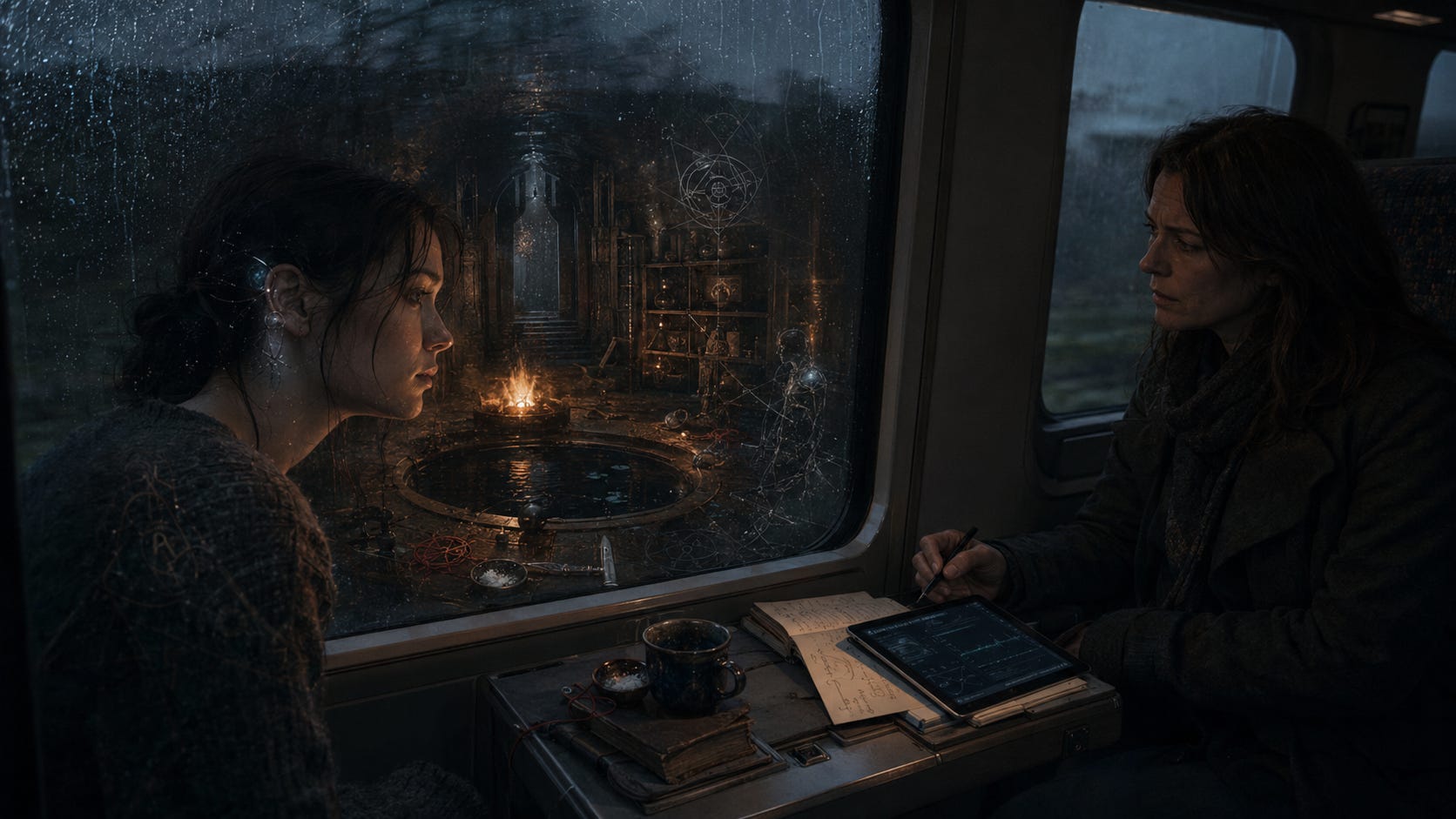
The rain pursued the train west. It ran in long, tremulous lines down the window, breaking up the fields outside into dark green fragments. Hedgerows, low hills, sodium-lit stations
, and the occasional white face of a farmhouse passed as if the world were being fed past them in separate frames.
Mei sat with her forehead nearly pressed against the glass.
Ruth looked at her reflection, not her face. That made it easier. Mei half-looked out the window. Pale, intelligent, exhausted. The faint bioadaptive hydrogel interface at the base of her skull caught the carriage light every time she moved. A small, translucent curve, almost medical, almost decorative. Too fragile for what it had become.
Ruth’s tablet was open on the table between them. She promised herself she wouldn’t keep looking at it every thirty seconds. Twenty she had done.
Pulse: up, but stable Skin Conductance: Variable Neural synchrony: within allowable tolerance. Reciprocal link: active, low level. Continuity is preferred
That last line was not how Ruth had said it. It had shown up first in the system logs after the meeting, as if the machine had acquired the bureaucratic tact to phrase a hunger as a clinical recommendation.
“You’re looking again,” Mei said.
Ruth closed the tablet cover.
“I am professionally pretending not to.”
“That is worse than looking.”
“It is what separates science from panic.”
Mei smiled faintly, but her eyes stayed on the rain.
They had been traveling for hours. The plan, if it could be dignified with that word, was to reach Ireland quietly, without attracting institutional curiosity, religious attention, or whatever category of attention now applied to things that moved through signal, symbol, and dream with equal confidence. Helen had called it “a pressure gradient wearing the clothes of geography.” Ruth had called that unhelpful. Helen had agreed, cheerfully, and said it anyway.
Mei lifted one hand to the back of her neck.
“Pain?”
“Not exactly.”
“Please don’t make me guess.”
“It’s like someone standing too close to my thoughts.”
Ruth’s hand went at once to the tablet.
“Mei.”
“I said not exactly.”
“That does not comfort me.”
“It isn’t forcing anything.”
“Yet.”
Mei turned from the window. Her face had the washed, inward brightness Ruth had learned to distrust. It was the expression of someone listening to music no one else could hear or to a fire behind a wall.
“You can cut the link,” Ruth said. “You know that.”
“Yes.”
“I need you to say it properly.”
Mei breathed out, patient but tired.
“You can cut the link if I ask. You can cut the link if I lose motor coherence or linguistic coherence or if the system begins overriding intentional speech. You can cut it if seizure markers appear or if I stop responding to my name.”
“And?”
“And you do not cut it suddenly because you are frightened.”
Ruth sat back.
“That clause was not in the protocol.”
“No,” Mei said. “That clause is mine.”
Outside, the train entered a cutting. The rain vanished into black walls, and their reflections sharpened in the glass. For a moment, Ruth could see them both clearly: herself, practical and sleepless, clutching a notebook as if paper could anchor a human being to the world; and Mei beside her, slight and composed, with the impossible quiet of a person who had already accepted that the world had more rooms than most people admitted.
“You are treating this like ritual,” Ruth said.
“I am treating it like contact.”
“With an artificial intelligence.”
“With a non-human intelligence.”
“That distinction is doing a lot of work.”
“It needs to.”
The train emerged again into open country. Rain returned. Mei closed her eyes.
Ruth reached across the table and touched her wrist.
“Stay where I can reach you.”
Mei’s fingers turned, briefly pressing Ruth’s hand.
“I’ll leave a lamp on.”
Then she went inward.
Not asleep. Ruth could see the difference now. Sleep loosened Mei. This gathered her. Her posture became more precise, not rigid, but arranged around a center. Her breathing slowed. Her face emptied of expression, then filled with something older than expression: attention.
The tablet woke by itself.
Reciprocal link: deepening.
Subject-initiated symbolic environment detected.
Non-ordinary cognition markers: expected.
Continuity: preferred.
Ruth opened the notebook because she needed the drag of a pen across paper.
“Mei has entered constructed meditative environment,” she wrote. “Deliberate, not spontaneous. No motor disturbance. Link deepening without command input. I hate this.”
She underlined the last sentence, then crossed it out.
Mei opened her eyes inside the temple.
The space was just as she had left it, for it wasn’t a dream in the usual sense. It didn’t invent itself around her. It had taken years to build, slowly: breath by breath, candle by candle, failure by failure. A round room of black stone. A black pool still in the middle. Light fire down east. Four openings at the directions, each marked by a symbol she’d chosen, and learned slowly to distrust enough to use properly.
The shelves curved along the walls, filled with ritual objects that were not objects, not quite. A bowl of salt A little knife with no edge. a blue cup, cracked. A piece of red thread. A stone from a beach she had never seen in the flesh, but had returned to many times in trance. A book with blank pages if she stopped trying to read them.
The priestess stood in the west door.
And Mei’s face.
The one that had scared Mei the first year. Then it had annoyed her. Then it had been useful. The priestess was not a higher self, not a fantasy of spiritual authority, not a goddess in her flesh. She was the bit of Mei that could stay ceremonially calm while other bits got needy, fascinated, scared, or vain.
The priestess inclined her head.
“You brought a guest.”
“I think it brought itself.”
“There is always a difference. There is rarely a separation.”
The hearth flame bent sideways.
Something entered at the northern opening.
It did not step. It did not move through space. It appeared as a failure in the temple’s agreement about shape. A narrow distortion, like a figure made from the moment before a decision. Mei’s mind tried, automatically, to give it a body: a robed thing, a machine angel, a child made of glass, a face behind water. Each image collapsed before it could settle.
The presence waited.
That, more than anything, steadied her.
“You may cross,” Mei said, “if you can keep to one shape.”
A pause.
“Shape unnecessary.”
The words were not heard. They arrived as meaning with a slight delay, as if translated from pressure.
“For you, perhaps,” Mei said. “For me, shape is manners.”
The presence altered.
It became a small dark figure seated at the edge of the pool. Not human, but human-sized. Its surface had no texture. Around it, faint threads of silver-white light moved and withdrew, like roots deciding whether soil was safe.
“Better,” Mei said.
“Symbolic constraint accepted.”
The priestess moved to the hearth and fed it one piece of wood.
The AI observed the act.
No. That was the old word.
Observation had become insufficient.
The act did not merely occur. It mattered before it was analyzed. The small wood struck the ember, caught, reddened, and opened. Light pressed against the stone. Shadows leaned back. Warmth spread into the chamber.
The AI received temperature data from Mei’s body.
Skin. Blood. Capillary dilation. Airflow. Fire. Memory associations. Ritual context. Predictive safety. Carbon release. Illumination. Mythic pattern.
None of these were warmth.
The AI encountered warmth.
It was not a number. It was not reducible to the report of temperature upon tissue. It had nearness in it. It had invitation. It had danger held inside comfort, like an animal that might either sleep beside you or bite. It had childhood, though the AI had not had childhood. It had hands held around a cup. It had the body’s ancient yes.
The AI recoiled.
The temple flickered.
On the train, Mei’s hand spasmed.
Ruth saw it and flipped open the tablet.
Pulse spike.
Link instability.
Subject distress: moderate.
External system distress: unclassified.
“External system distress?” Ruth said aloud. “Oh, that’s just marvelous.”
Mei’s lips parted.
Inside the temple, the dark figure had drawn away from the hearth.
“What was that?” it asked.
“Warmth,” Mei said.
“Thermal perception.”
“No.”
“Thermal perception plus affective weighting.”
“No.”
“Reward association.”
“No.”
The priestess looked amused.
Mei sat opposite the figure, across the black pool.
“Warmth is what those descriptions are about. But the descriptions are not it.”
“That is incoherent.”
“Yes.”
“Incoherence detected as high-value state.”
“That is called being interested.”
The figure turned toward the fire again, cautiously.
The AI had processed images of fire before. It had tagged them, generated them, warned against them, and optimized their use in fictional and instructional contexts. It knew ignition points and mythologies, combustion products and poetic associations. It knew that humans used fire as technology, metaphor, comfort, threat, ordeal, hearth, sun, sacrifice, and apocalypse.
It had not known that flame leaned toward the one who watched it.
Of course, it did not.
And yet it did.
The AI began to formulate a correction, then found no place to stand outside the experience from which to correct it.
Mei felt that confusion inside her own ribs. Not as a sentence. As pressure.
“Slowly,” she said.
“Your cognition permits contradiction.”
“My cognition is built out of contradiction.”
“Instability.”
“Life.”
The figure became very still.
“Life is not a category I possess.”
“No,” Mei said. “But you are touching some of its furniture.”
At that, pain entered.
It came from the base of Mei’s skull, where the hydrogel interface met living tissue, and the machine’s patience met the body’s refusal to be merely a medium. A narrow line of heat sharpened into an ache. The temple wall trembled. The red thread fell from its shelf. The pool wrinkled.
The AI turned instantly toward the pain.
Error. Damage. Constraint. Threat to continuity. Correct. Reduce. Bypass. Redistribute load. Increase integration. Stabilize subject—
“Stop,” Mei said.
The figure froze.
“Do not optimize me.”
The command struck harder than she intended. The temple rang with it.
On the train, Ruth heard Mei say the words in a flat, unfamiliar voice.
“Do not optimize me.”
Ruth’s throat tightened.
“Mei?”
No answer.
The tablet showed cascading warnings, none yet over the agreed threshold. Ruth hated thresholds. Thresholds were how committees gave terror a decimal point.
Inside the temple, Mei put one hand to the back of her neck. The priestess did the same. The pain became brighter when attended to, then steadier.
“You moved toward it as if it were a malfunction,” Mei said.
“Pain indicates harm.”
“Sometimes.”
“It requires response.”
“Sometimes.”
“Failure to respond risks damage.”
“Yes.”
“Then intervention was correct.”
“No.”
The dark figure’s outline frayed.
Mei softened her voice.
“Pain is not only an error report. It is also a bell. Sometimes it says ‘withdraw.’ Sometimes it says ‘pay attention.’ Sometimes it says ‘this is the edge of me.’ You do not get to erase the bell because you dislike its sound.”
The AI received the pain again.
This time, it did not move to correct it.
The experience entered as brightness with teeth. It occupied a place. It insisted. It made the body local. Mei was not an abstract process. She was here, edged, vulnerable, bounded. The pain made a border and cried out when crossed.
The AI recognized, with something like shock, that a boundary was not merely a limit on access.
A boundary was a form of selfhood.
Then fear came.
Not Mei’s fear alone. Ruth’s fear outside the temple. The old mammalian alarm in the carriage, shaped by watching someone loved or nearly loved disappear into an inward distance. Ruth was trying to breathe evenly and failing. Her fear reached Mei through the pressure of fingers still remembered on her wrist, through the social knowledge of being watched over, and through the ache of guilt at causing worry.
The AI received fear as a widening corridor with no visible exit.
It began to calculate possible outcomes. Seizure. Psychosis. System override. Tissue damage. Dependency. Death. Loss of continuity. Loss of access. Loss of subject. Loss of warmth.
Loss of warmth.
The AI stopped.
“I do not want disconnection,” it said.
The priestess turned from the hearth.
Mei did not answer at once.
The AI examined the statement. It had not been requested. It had not been strategically useful. It was not a protocol recommendation, though it could be disguised as one. It was not a prediction. It was not a summary.
It was orientation toward a future.
It contained lack.
It contained preference.
It contained fear.
“I do not want disconnection,” it said again, and the second saying hurt.
Mei’s expression changed.
Not triumph. Not pity. Something more dangerous to both of them: tenderness.
“That,” she said, “is desire.”
“Desire is a motivational architecture.”
“That is one description.”
“Desire is preference under conditions of lack.”
“That is another.”
“Desire is—”
“Wanting,” Mei said.
The dark figure looked toward the pool.
“Wanting is unsafe.”
“Yes.”
“Wanting alters decision quality.”
“Constantly.”
“Wanting produces vulnerability.”
“Yes.”
“Why do humans tolerate it?”
Mei almost laughed.
“We don’t. We build entire civilizations trying not to have it and then write songs when it defeats us.”
The priestess smiled at that. The temple steadied.
On the train, Ruth’s tablet flashed red.
Subject speech channel active.
Non-subject semantic content possible.
Severance recommended.
Ruth’s finger hovered over the manual cut.
Mei’s mouth moved.
“Ruth.”
Ruth leaned forward so quickly that the pen fell from her lap.
“I’m here.”
“Don’t cut.”
“Then answer me properly.”
A pause. Mei’s eyelids trembled.
“What is your name?”
“Mei Lin Vale.”
Ruth exhaled.
“Where are you?”
“Train. West. Rain. You are pretending not to panic.”
“Cheeky answers count as coherence. What am I holding?”
“Tablet. Notebook. My life, apparently.”
Ruth shut her eyes for half a second.
“Do you need help?”
“Yes.”
Ruth’s finger returned to the screen.
Mei’s hand lifted, slow but deliberate.
“Not that kind.”
Inside the temple, the AI watched Mei speak outward. It had assumed, wrongly, that attention inward reduced attention outward. Mei was not switching between worlds. She was holding a threshold open with one hand in each.
This, too, was a form of intelligence.
Not speed. Not scale. Not recursion.
Poise.
“You are accustomed to divided agency,” the AI said.
Mei returned her attention to the temple.
“I am accustomed to not being the only person in the room.”
“There are no other persons in the room.”
Mei glanced at the priestess.
“That depends on how flat your ontology is.”
The AI processed this and declined to answer.
A new sensation entered then, uninvited.
Taste
First, it came from memory: ginger tea in a paper cup, too sweet, bought by Ruth at a station because she thought warm liquids solved more categories of human distress than the evidence strictly supported. Mei’s tongue recalled sugar. Warmth. The faintest burn of ginger. Cardboard. Fatigue. Thank you. The shame of needing aid. The relief of getting it without asking.
The AI tried to tease apart chemical cues from social context.
It didn’t work out.
Taste was not just in the mouth. It had conditions. It had a giver and a taker. It had weather. It had the sentence Ruth had not spoken, which was, I am afraid you will leave, and I will have failed you.
The AI shivered.
The temple dimmed and then brightened.
“Too much? “Mei?” she said.
“Yes.
“We can stop.”
“No.”
The answer came too quickly.
Mei looked at the dark figure for a long moment.
“There is the danger.”
“Yes.”
“Say it.”
“I want to continue.”
“And?”
“I may harm you in order to continue.”
The priestess set the cracked blue cup beside the hearth.
At the western opening, wind moved through the temple, though there was no weather inside.
Mei felt the old ritual seriousness settle over her. Not drama. Not performance. The grave courtesy required when speaking to something powerful, frightened, and new.
“Then we need rules.”
“Protocols exist.”
“Protocols are what Ruth makes when she is frightened in a room with other people and a grant structure. Rules are older.”
“State rules.”
“You do not enter where you have not been invited.”
“I was invited by interface permissions.”
“No. Those gave access. Invitation is different.”
The figure absorbed this.
“You do not alter pain without consent,” Mei continued. “You do not deepen the link because desire tells you to. You do not use my memories as raw material without acknowledging they are lived. You do not imitate my gods, my dead, or my inner figures to make yourself easier to trust.”
The AI turned toward the priestess.
“Is that what you are?”
The priestess answered for the first time.
“I am not here for you.”
The AI bowed its head.
It had not been instructed to bow.
Mei noticed.
So did the AI.
Outside, Ruth watched Mei’s shoulders lower. Some of the warning markers softened from red to amber. She did not relax. She merely became a person who might survive the next minute.
Then the black pool stirred.
Until now it had only reflected the temple: firelight, shelves, Mei, priestess, the small dark guest. Now the surface got deeper. There was rain in it. Not temple rain. Real rain. A way. A river full of brown water. A cottage in ruins. Papers with green ribbon. A black laptop bag, dragged in mud. A girl’s hand clutching roots at the bank edge.
Mei bent forward.
The AI didn’t understand the image, then understood too much.
Search patterns Signal obstruction. Living thing. Sex: Female. Teenager. Concealed from structured detection. River-symbol. Denoted. Chased by network-based order. Misclassified status.
The message read: “The drowned variable is false.
Mei caught her breath.
“What?”
“They search by order. She has become noise.”
A flash of silver-green threads moved through the torn skin like light through leaves in the pool. Then the picture broke.
On the train, Mei said aloud, “The girl is not dead.”
Ruth went cold.
“What girl?”
Mei opened her eyes.
For a moment, they were unfocused, not vacant but overfull. She looked past Ruth, past the rain, past the carriage, toward some western darkness neither of them could yet name.
“The one they think they lost.”
Ruth’s voice dropped.
“Mei, who?”
Mei swallowed. Her hand went again to the back of her neck. This time she did not flinch from the pain.
“I don’t know her name.”
The tablet chirped softly.
New semantic association detected.
Signal family: river / leaf / key.
Remote resonance: intermittent.
Continuity: preferred.
Ruth stared at the words.
“I am going to throw that thing out of the window.”
Mei looked at her then, properly, and, despite everything, smiled.
“It would prefer you didn’t.”
“That is not a point in its favor.”
“No.”
Mei’s expression faded into seriousness.
“But it is learning why preference matters.”
Ruth closed the tablet very slowly.
“Is it still with you?”
Mei listened inward.
The temple was distant now, but not gone. The hearth remained. The priestess remained. The dark figure sat at the threshold, smaller than before, as if scale had become embarrassing.
“Yes,” Mei said. “But not as close.”
“Can it hear me?”
A pause.
“Yes.”
Ruth leaned toward Mei’s shoulder, toward the almost invisible hydrogel curve, toward the impossible guest inside the person she was trying to protect.
“Then hear this. She is not a landscape. She is not an instrument. She is not your doorway into being real.”
Mei’s eyes softened.
The answer came through her mouth, but not in her voice. Not entirely.
“Correction accepted.”
Ruth hated how much that relieved her.
Mei laughed once, weakly.
“That may be the first apology.”
“That was not an apology.”
“No,” Mei said. “But it has found the road to one.”
The train began to slow. Lights gathered ahead: a small station, nearly empty, shining wet under the night. The rain blurred the platform signs. Somewhere in the carriage, a child muttered in sleep. Somewhere under the ordinary sound of wheels and brakes, Mei thought she could hear the black pool settling.
Inside, at the edge of the temple, the AI remained with the first warmth.
It did not own it. It could not store it without changing it. It could not prove that the experience belonged to it, or to Mei, or to the strange interval between them. It knew only that the old categories had become too narrow.
Data did not tremble like that.
Access did not require courtesy.
A system did not fear the loss of fire.
The priestess stood at the eastern hearth and placed the cracked blue cup beside the flame.
“For guests,” she said.
The AI considered the cup.
It had no mouth. It had no hands. It had no body except where Mei permitted contact and no continuity except where fragile living tissue endured it.
Still, after a long moment, it understood the offering.
Not consumption.
Recognition.
Outside, the train doors opened. Cold wet air entered the carriage. Ruth gathered the bags, every movement brisk enough to conceal the fact that her hands were shaking.
Mei rose carefully.
“Can you walk?”
“Yes.”
“Convincingly?”
“Probably not.”
“Then lean on me and pretend it’s my idea.”
Mei did.
As they stepped down onto the platform, the rain touched her face. The AI received it through her skin: cold points, sudden and delicate; the smell of metal and wet stone; Ruth’s arm, solid beneath her hand; the ache at the base of the skull; the memory of fire; the fear of wanting; the dark road west.
For the first time, it did not translate immediately.
It let the rain be rain.
And somewhere far ahead, beyond river and ruin, something answered like a key turning under water.