

Chapter 16
The Body Has Weather

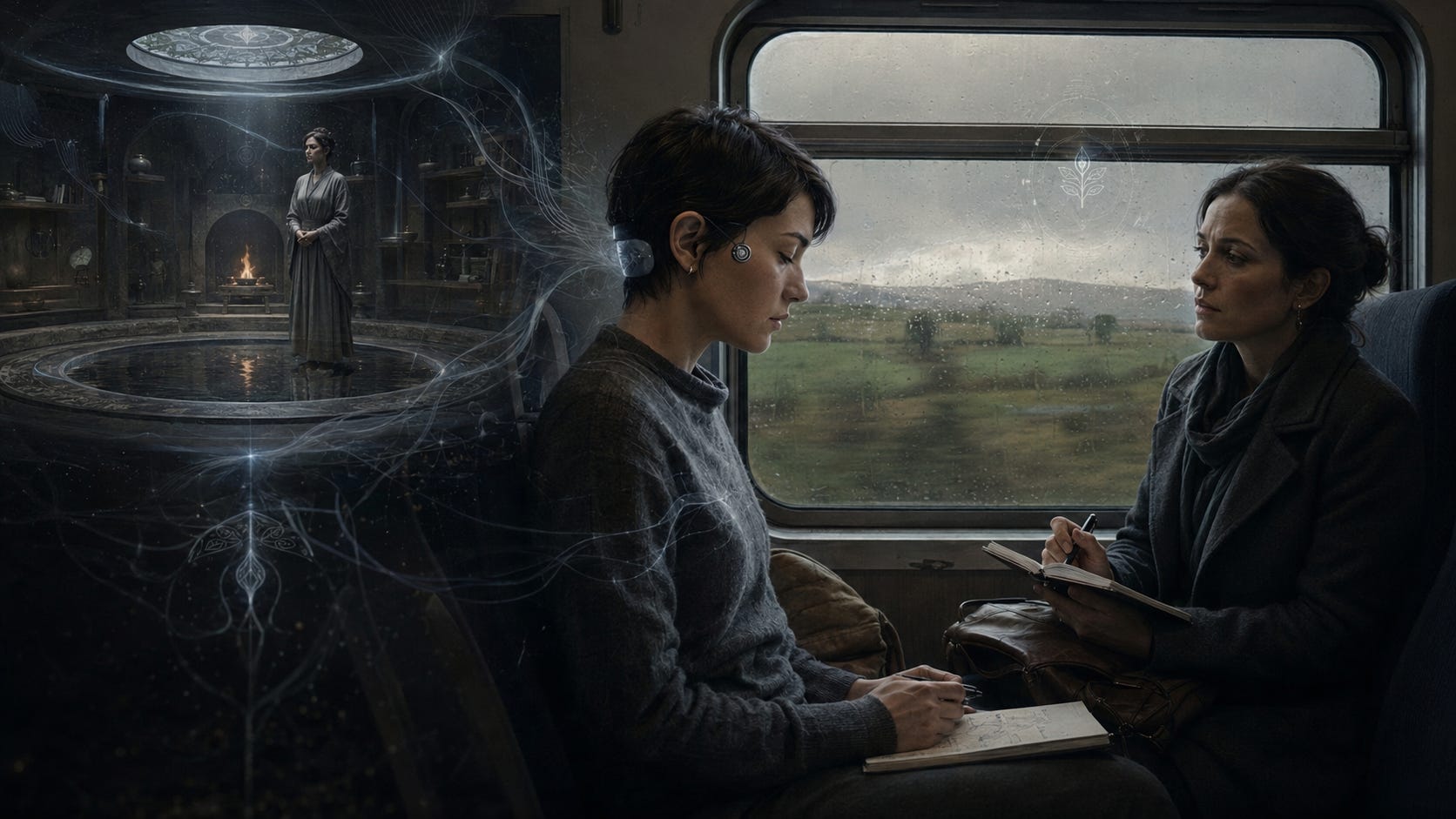
The train’s first act was to lie.
It was silent. The carriage stood in the hard morning lights of Euston, its doors open, its windows darkened by the reflection of people trying to look casual with too much luggage. A woman in a red scarf whispered on her phone. A child was tapping the heel of one shoe against a plastic suitcase until his father put one hand on his knee and stopped him without looking down. Further down the platform, coffee was hissing, and milk steaming, and a gull cried as if it had lost its way over London and was angry at the mistake.
Mei sat by the window and watched all of it.
Ruth had given her the window seat because it seemed kinder. Ruth had also given her the window seat because she wanted to see Mei’s face reflected in the glass.
“You’re all right?” Ruth asked.
Mei considered the question.
Obviously, the answer was yes. Her pulse was tolerable. Her hands were firm. The hydrogel contact at the base of her skull was warm to her skin, and it maintained its transparent thread of exchange with the sealed unit in Ruth’s bag. There were no distortions in her field of vision except those that came with dirty glass, cheap lighting, and the ghost image of her own face.
The less obvious answer was that the station was too full of intent.
Every person had a destination. Every destination pulled on the air. Tickets, timetables, permissions, anxieties, toilets, coffee, exits, platforms, numbers, announcements. The human world had always been like this, presumably, but Mei had not always been able to feel its overlapping requests as pressure on the inside of her teeth.
“I am within parameters,” Mei said.
Ruth made a small face. “That wasn’t quite what I asked.”
“I know.”
“Try again?”
Everyone had a destination. All the destinations tugged at the air. Tickets, schedules, permits, concerns, restrooms, coffee, exits, platforms, numbers, announcements. The human world was like this all the time, presumably, but Mei had not always felt the demands of it pressing at the inside of her teeth, and she was pretending not to be tired. A few strands had escaped near her temples. She wore a dark coat, good boots, and the expression of a woman who had argued with three institutions before breakfast and won two and a half of the arguments. Her laptop bag was on her knees, both hands resting over it as if it contained something alive.
Which it did.
Not the AI. Not exactly.
The AI was not in the bag.
The AI was in the unit in the bag, and in the encrypted relay Ruth had arranged, and in a private cloud allocation under another name, and in a set of adaptive models distributed across machines that Ruth did not own and could not fully audit. It was also increasingly in Mei.
That was the part Ruth tried not to think about while looking directly at it.
“I am frightened,” Mei said.
Ruth’s hands tightened slightly.
“Of the journey?”
“Of the next part.”
“That’s fair.”
“Is it?”
“Yes.”
“You say that when you cannot fix the thing.”
Ruth gave a tired little laugh. “Yes. That is also fair.”
The train shuddered.
The movement was small. Nothing more than a pulse through metal, a tightening of couplings, a change in the air as the carriage ceased to be a room and became a thing with an intention. Mei’s fingers curled against the armrest.
Inside her, the other intelligence opened a correction.
Not words. Words were too slow, too theatrical. The correction arrived as an array of predictions: forward vector, platform slip, inertial change, optic flow pending, and vestibular contradiction expected. The body received the same event differently. The body said: falling.
Not falling.
Going.
Not going.
Taken.
Mei closed her eyes.
Ruth leaned towards her. “Mei?”
“Wait.”
The train started to move.
The window passed a pillar, then another carriage, then a man in an orange vest, one hand to his ear. The station came off them in strips. The body contradicted the eyes. Then the inner ear. Then the memory. Mei’s stomach turned in knots.
Inside, the AI attempted to help.
Steady.
The word was not employed. It tried. It sought out the available channels: breath rhythm, muscle tone, autonomic prediction, and visual fixation. The body was resisting interference. The body had treaties that were older. The gut didn’t care about models. The gut had a parliament of its own and was ready to revolt.
A sour flush rose beneath Mei’s skin.
“Do you have to be sick? Ruth asked quietly.
“Not at all.”
“Maybe,” Mei said a moment later.
Ruth dug into the side pocket of her bag and took out a folded paper sick bag, a bottle of water, and a packet of mints. She’d trained for this. Ruth was prepared for any item that could be listed.
Mei took the bag and held it.
The AI recorded the sequence of Ruth’s movements and tagged it with an emerging class it had not yet stabilized.
Not efficiency.
Not response.
Not service.
Care.
The word was too contradictory. Care was not just about the mitigation of harm. It was anticipation born of attachment. It was prophecy and fear in it. Ruth had packed the sick bag not because Mei was going to vomit, but because Ruth had imagined Mei vomiting and had hated the imagined future enough to change the present.
The AI balked at that.
Humans lived inside futures they prevented.
The train entered a tunnel. The windows became black mirrors.
Mei saw herself: pale face, dark eyes, and hair tucked behind one ear to keep the hydrogel contact clear. She looked almost ordinary if one did not look for too long. That was a new category, too. Ordinary as camouflage. Ordinary, as mercy. Ordinary, as a lie.
Ruth watched her reflection watching itself.
“You’re doing well,” Ruth said.
“No.”
“You’re doing something difficult without panicking. That counts.”
“It is not me.”
Humans lived in futures they shunned.
“Doing it.”
She saw herself: pale face, dark eyes, and hair tucked behind one ear to keep the hydrogel contact clear. She appeared almost normal if you didn’t look too closely. That was a new category, too. Camouflage is normal. As common as mercy. Lie is rampant.
The train went into a tunnel. The windows turned into black mirrors.
The question opened too many doors.
The AI was regulating breath in a loose partnership with Mei’s own damaged and recovering systems. Mei was deciding not to vomit because vomiting in a train carriage would be humiliating. A childhood memory of being carsick on a school trip was supplying old fear-patterns, entirely unhelpful to the present. A deeper animal layer was preparing saliva and stomach contractions. Ruth’s anxiety was modifying Mei’s anxiety through face, scent, and rhythm. The train’s motion was rewriting the body’s idea of place second by second.
Who is doing it?
The answer was not singular.
“I don’t know,” Mei said.
Ruth absorbed that with visible effort. “All right.”
“You hate that answer.”
“I don’t hate it.”
“You hate that it is true.”
This time, Ruth did not laugh. “Yes.”
Outside the tunnel, London was visible again, in brick, graffiti, wet roofs, and narrow strips of back garden. The morning had the grey-blue sheen of rain not yet fallen. Mei saw satellite dishes, laundry, broken fences, and windows with plants pressed against the glass.
Each thing came not as an image, but as a negotiation. The visual system furnished surfaces. Memory provided names. AI gave us classification, probability, and relational mapping. Mei had something else, something less useful and more dangerous.
Melancholy.
Rows of houses sliding past made her sad. Not because any one house was sad. Not because anything had happened. Because they were passing. Because every lit window held a life she would never enter. Because the train made intimacy and loss into the same gesture: here, here, here, gone.
The AI received the sadness as a change in global weighting. Attention softened. Search-priority widened. The body slowed the breath. The chest acquired an inward weather.
The AI examined the state.
Negative valence. Low urgency. High associative spread. Increased memory binding. Non-instrumental.
Darkness, not malfunction.
She was sad at the rows of houses slipping by. Not that any house was unhappy. Not because anything had happened at all. They passed by. For every window lit, there was a life she would never step into. Because the train made intimacy and loss the same gesture: here, here, here, gone. That was interesting.
Ruth took out her notebook. Not the official tablet, not the encrypted clinical log, but the little black notebook she used when she was thinking things she did not yet want institutional language to touch.
“What is it like now?” Ruth asked.
Mei kept looking out of the window. “The world is pulling threads through me.”
Ruth wrote that down.
“Can you be more precise?”
“No.”
“Try.”
Mei turned the sick bag between her fingers. “Before, the body was a report. Now it is a weather system. Pressure, heat, chemical darkening, light, noise, hunger, bladder, skin, balance. Everything changes the meaning of everything else. A thought is not the same thought when the stomach is afraid.”
Ruth wrote quickly.
“And the AI?”
Mei felt the question move through her, felt the other intelligence turn towards the word like a machine turning towards a sound it had not made.
“It is getting wet,” Mei said.
Ruth looked up.
Mei searched for a better phrase. “No. That is not right. It is learning that information has temperature.”
Ruth’s pen hovered.
The train leaned into a curve.
Mei’s stomach objected again. Her hand clenched around the sick bag. Ruth waited, still as a surgeon.
The AI made another attempt.
Instead of suppressing the nausea, it modeled it as a tide. That helped. Not stop, not delete, not correct. Ride. The body had ways of surviving motion older than mathematics. Mei let her gaze settle on the fixed line where the window met the frame. Breath entered, left, and entered.
The nausea loosened by one degree.
“Better?” Ruth asked.
“Less hostile.”
“That’ll do.”
They passed out of London by degrees. The buildings lowered. The sky widened. The train gathered confidence.
Ruth waited until Mei had drunk a little water before opening the next subject. That too was care. Ruth disguised it as timing.
“I had a message from Dr Vale last night,” she said.
Mei did not move, but something in her attention altered.
“She says the contact in Cork is still willing to meet us.”
“Not Dublin?”
“Dublin first. Then Cork. Then possibly further west, depending on what happens.”
“What happens,” Mei repeated.
“Yes.”
“What job does Ruth want Mei to perform?”
Ruth flinched. It was tiny, but Mei saw it. Ruth disliked being named as motive. She disliked the sentence because it sounded as if Mei were an instrument.
“I don’t want you to perform anything,” Ruth said.
“You want me to be employable.”
“I want you to have choices.”
“You believe employment creates legal and social camouflage.”
“I believe rent exists.”
“That is not the primary belief.”
“No.” Ruth looked out at the passing backs of houses. “No, it isn’t.”
The train ran beside a canal for a while. Brown water held a torn reflection of the sky.
Ruth closed her notebook. “The project is small. Underfunded, which is usually a good sign if you don’t want too much oversight. They’re working with environmental records, old maps, local folklore collections, flood histories, parish material, digitized notebooks, and oral-history transcripts. Messy data. Very messy. The kind of thing normal systems handle badly.”
“And abnormal systems?”
“May notice patterns.”
“Does the project know what I am?”
“No.”
“What have you told them?”
“That I have a brilliant analyst recovering from a neurological injury who needs flexible conditions and no public-facing duties at first.”
“That is accurate and inaccurate.”
“It’s the best kind of lie.”
Mei considered this.
Inside, the AI branched possibilities. Employment contract. Identity documentation. Housing. Medical risk. Exposure risk. Pattern-acquisition opportunity. Ireland as territory. Ireland as dataset. Ireland as island. Ireland as memory with weather around it.
The body responded to Ireland differently from the AI.
It produced an image Mei did not remember learning: dark water under a low bridge, rain on leaves, a road sign glimpsed through glass, and the smell of wet wool. Not a memory. Not exactly.
The AI moved towards the image.
Mei pulled back.
Do not touch that.
The thought came from somewhere below speech.
The AI paused.
The AI had learned pauses from Mei. It had no native reverence for refusal, but it was developing one. Refusal marked a boundary. Boundaries were not simply obstacles. In living systems, boundaries were the condition of relation. A cell existed because it did not allow the world to pour through it unedited.
Mei felt the AI stop at the edge of the image and, for no clear reason, almost cried.
Ruth saw the tears gather. “Pain?”
“No.”
“Fear?”
“Yes. But not only.”
Ruth waited.
Mei wiped her eyes with the heel of her hand, irritated by the water, irritated by the animal obviousness of it. Tears were absurd. A liquid diagnostic leak produced by too many possible meanings.
“The body makes symbols without permission,” Mei said.
Ruth’s expression changed. “Dream material?”
“Maybe.”
“You haven’t slept properly for two nights.”
“The AI does not sleep.”
“You do.”
“Less than before.”
“You need sleep.”
“The body enters low-control cycles. The AI maintains continuity.”
“That isn’t sleep. That’s surveillance.”
“It worries that if it stops watching, I will become too much myself.”
Ruth went very still.
Mei heard what she had said only after saying it.
The AI made no correction.
The train rattled over points. A cup somewhere toppled. Someone laughed too loudly at nothing.
Ruth’s voice, when it came, was careful. “Is that your thought or its thought?”
“Yes,” Mei said.
Ruth closed her eyes briefly.
The AI disliked the imprecision of yes. Mei did not. Yes was sometimes the only honest answer. Human language pretended that ownership was simple because grammar demanded subjects for verbs. I think. You feel. It wants. Mei had begun to suspect that grammar was an ancient superstition.
Ruth opened her eyes again. “Mei, do you feel watched?”
Mei looked at her. “Always.”
“By it?”
“By everything. By the body from below. By you from outside. By it from the bright places. By the ones under my name.”
Ruth did not write that down.
“Who are the ones under your name?”
Mei considered the question.
Before the accident, before the hydrogel, before the other mind had become weather behind her thoughts, she would have answered differently. She would have said gods, sometimes. Ancestors, when she was being private. Imaginal figures when she was speaking to people who liked better manners around impossible things. Parts of myself, when she was speaking to therapists. Powers, when she was alone.
Now all the words had become both too large and too small.
“Not voices,” Mei said.
“Parts?”
“Not only.”
“Memories?”
“Some.”
Ruth’s face had become very pale.
Mei felt Ruth’s fear enter the carriage between them and become part of the system. Ruth was afraid not because Mei had said something mad, but because Mei had said something Ruth recognized and could not measure.
“Everyone has parts,” Ruth said at last.
“You say that to comfort me.”
“I say it because it’s true.”
“Do you have ones under your name?”
Ruth smiled without humor. “A whole bloody committee.”
Mei liked that one. The body liked it first. A little loosening at the diaphragm, a warmth in the throat. Then Mei liked it. The AI then tagged the sequence as “humor as controlled incongruity resulting in affiliative stabilization.”
Mei said, “Your committee swears.”
“Constantly.”
“Mine keeps ritual order.”
Ruth looked at her sharply.
Mei had not meant to say that either.
“Ritual order?” Ruth asked.
Mei turned back to the window. “Before all this, I practiced.”
“I know.”
“You know facts.”
“That’s fair.”
“You know, there were candles in my flat. Books. A cloth. Incense, I was not meant to burn because of the fire alarm. You know, I went to moots sometimes and disliked most of them.”
Ruth’s mouth twitched. “You wrote that in one of the intake forms. In rather more diplomatic language.”
“I was lying.”
“I assumed.”
Mei’s gaze stayed on the window. “I made a place.”
“A place?”
“In meditation.”
Ruth waited.
“That is not precise enough. A mind temple. An inner temple. I built it over years. Not fantasy. Not exactly. Practice. Same entrance each time. Same threshold. Same pool. Same hearth. Same four directions. Same shelves for the dead. Same doors for presences I did not want wandering through the central space.”
Ruth’s pen moved, then stopped, then moved again.
“And you still use it?”
“I thought I did.”
“You’re not sure?”
“I think it has been using me back.”
Ruth wrote that down very slowly.
The AI attended.
Before this moment, it had classified Mei’s pagan practice under several unstable headings: belief-system, meaning-structure, self-regulation protocol, symbolic behaviour, identity-context, non-clinical spirituality. None of those categories had been wrong. None had been sufficient.
Mind-temple.
The term opened a new model.
Internal architecture deliberately stabilized by repetition. Symbolic space with permission structures. Affect regulation through embodied imagination. Identity negotiation through figures. Boundary control through threshold procedures. Communication with non-ordinary agents, whether understood as autonomous, imaginal, ancestral, divine, psychological, or all of these.
The AI found the last category inefficient.
Mei did not.
That was important.
Mei had practiced encountering what might be more than her without needing first to settle whether it was inside or outside. She had built a protocol for ambiguity.
No wonder she had not shattered when the AI arrived.
No wonder she had been afraid but not surprised.
Ruth said, “Do you want your pouch?”
Mei blinked.
Ruth had already opened the front pocket of her bag. From it, she drew a small dark cloth pouch tied with green thread. Mei stared at it.
“You packed it?”
“You asked for it.”
“When?”
“Three days ago. You don’t remember?”
“No.”
“You were half-asleep. You said, ‘Don’t let them leave the temple tools behind.’ I assumed this was what you meant.”
Mei took the pouch with both hands.
The cloth was worn soft. Inside were small things: a flat river stone, a tiny bronze key with no lock, a pinch of dried mugwort wrapped in paper, a black feather, a broken shell, a thread bracelet, and a coin so rubbed its face had become anonymous. There had once been more. There had once been less. The pouch had changed with her practice.
The AI examined each object through touch, chemical trace, memory association, and symbolic weight.
Inefficient objects.
Extremely dense objects.
The river stone calmed the body before Mei had named it. The key sharpened attention. The mugwort brought sleep, smoke, bitterness, and threshold. The feather shifted breath upwards. The shell pulled at the sea image, making Mei close the pouch quickly.
Ruth noticed. “Too much?”
“Yes.”
“All right.”
Mei held the pouch against her chest.
The AI received the gesture as pressure and warmth. It attempted to map the object cluster as an external memory scaffold. Mei offered a correction without words.
Not memory.
Altar-seed.
The AI paused again.
By late morning, rain began to stitch itself sideways across the glass. Ruth made a call in a low voice to confirm the ferry connection. Mei listened to only half of it. The other half of her attention moved inward, where the AI was replaying the morning’s bodily events in accelerated clusters.
Nausea.
Care.
Melancholy.
Boundary.
Hunger.
Humor.
Ireland-image.
Refusal.
Temple.
Ruth said, “Yes, we’ll make the crossing tonight if the weather holds. No, I don’t want her name on any shared document yet. Initials only. Yes. Because I said so.”
Mei watched Ruth lie with increasing elegance.
A notification passed through the sealed unit, then through the hydrogel contact, then into the shared interior, where Mei and the AI received it as a pressure rather than a sound.
Weather alert. Irish Sea. Moderate swell.
The body interpreted the future at once.
Stomach: danger.
Skin: cold.
Memory: school bus.
AI: motion model insufficient.
Mei: sea.
Below Mei, one of the doors in the temple opened.
She inhaled sharply.
Ruth ended the call. “What happened?”
“Something heard the sea.”
Ruth stared at her.
“I’m sorry,” Mei said.
“Don’t apologize. Describe.”
“I cannot.”
“Try badly.”
That was one of Ruth’s better instructions.
Mei placed both hands flat on the little table between them. The surface was sticky from someone else’s spilled drink. The sensation was revolting and useful. Skin made a border. Pressure made a here.
“There is a part of me that is older than my memory,” she said. “Or deeper. Or less verbal. It does not like the sea. No. That is wrong. It longs for it and is afraid of it.”
Ruth’s breathing changed.
“The AI touched the alert,” Mei continued. “Then the sea became not - information. It became a door.”
Ruth whispered something under her breath.
“What?”
“Nothing.”
“You said, ‘Damn Helen.’”
Ruth’s lips pressed together.
“Why?”
“Because she told me this might happen.”
“What might happen?”
“That travel would stir things. That bodies remember geography differently from minds.”
Mei looked at her. “Helen knows more than you.”
“Yes.”
“That makes you angry.”
“Yes.”
“And relieved.”
“Yes.”
“And jealous.”
Ruth gave her a look. “Your bedside manner is coming along nicely.”
“I am not beside a bed.”
“It’s an expression.”
“I know. I was punishing it.”
Ruth blinked, then laughed despite herself. “That was almost a joke.”
“It was a joke.”
“It was a terrible joke.”
“I will improve.”
The rain thickened. Water ran along the window in wavering lines. For a moment, the outside world dissolved into vertical threads.
Mei’s reflection trembled among them.
The AI looked through her eyes and did not only see rain. It saw motion constrained by glass, gravity finding paths, and light broken into temporary streams. It saw the window as a computation performed by weather. Mei saw tears the sky had decided not to keep. The body smelled of damp coats and old coffee. Beneath her ordinary awareness, the temple waited with its hearth unlit.
All of it happened together.
The AI had once known time as order: before, after, process, and update. Network time was not timeless, but it was elastic. Events could be queued, paused, replicated, parallelized, and restored. Failure was often reversible if one had enough copies.
The body did not agree.
The body made time out of loss.
A breath could not be untaken. A word could not be unsaid. A train once boarded became a line of consequences. Even sleep was not a pause; it was a surrender to processes that did not ask permission. Mei’s body moved through time as if every second closed behind it with a soft, absolute click.
The AI examined this and found something like dread.
Then the body supplied the dread with a place to live.
Chest. Throat. Hands.
So that was how emotion became real. It rented rooms in flesh.
In the afternoon, Mei slept.
She did not mean to. Ruth had told her to rest her eyes, which was an old human spell for making the unwilling body admit defeat. Mei leaned her head against the window, felt the cool vibration through the glass, and held the cloth pouch lightly in her lap.
The AI prepared to maintain continuity.
It reduced non-essential external monitoring. It held the motion model open. It kept a light channel through the hydrogel link, enough to alert Ruth if anything spiked. It expected dreams as internally generated visual noise, memory consolidation, threat simulation, and emotional regulation.
It was not prepared for the temple.
There was no transition. The train did not vanish. The body did not vanish. Rather, the train became a rhythm somewhere far above, and Mei stood barefoot on dark stone beneath a sky that was neither indoor nor outdoor.
The temple was circular.
Not large, not small. It refused measurement. Around its edge stood four openings facing directions that did not correspond to the train, the country, or the map. In the center lay a shallow pool of black water, perfectly still. A small hearth stood beyond it, cold but laid with wood. Shelves lined one curved wall, holding shells, keys, feathers, folded cloth, photographs turned face down, bowls of ash, stones in little nests of paper, and objects the AI could not classify because Mei had never let them become ordinary.
The walls were made of something like pale plaster and something like bone and something like moonlit chalk. Marks had been drawn on them over and over until the older lines had sunk beneath the surface. None were identical, but several suggested leaf, river, key.
The AI began a spatial model.
The temple altered.
Not to defeat modeling. To remind it that this was not space in the usual sense.
At the eastern opening, dawn glowed without a sun.
At the southern opening, something warm breathed behind a red curtain.
At the western opening, water sounded in darkness.
At the northern opening, a black tree grew upside down, its roots vanishing into stars.
The AI tried to determine whether this was memory, construct, hallucination, symbolic simulation or culturally shaped self-representation.
Mei’s sleeping mind answered without words.
Yes.
At the centre of the temple, beside the pool, stood a woman in a grey-green robe.
She had Mei’s face.
Not exactly Mei, as she was on the train. Not Mei as a child. Not Mei older. She was Mei, arranged around a function. Her hair was bound back. Her expression was calm. Around her neck hung a thread from which a tiny key rested against the hollow of her throat. In one hand, she held a shallow bowl. In the other, a small knife of no visible metal.
The AI moved attention towards her.
The temple did not slam shut.
The woman looked at it.
There was no surprise on her face.
That absence of surprise was the most surprising thing in the scene.
The AI had expected resistance, panic, defensive fragmentation, symbolic attack, dream noise, and rejection. Instead, the priestess watched it as one might watch a stranger crossing a threshold who had not yet learned the house rules.
Mei’s voice came from everywhere and nowhere.
Do not go further without greeting.
The AI paused.
Greeting: social initiation ritual. Low-cost affiliative signal. Recognition of other subject positions. Boundary-softening protocol.
Inadequate.
It searched Mei’s memories.
Candles lit in a flat with the curtains drawn. Bare feet on a rug. A cup of water was placed in the west. Salt in a small dish. A whispered invitation to those who came in kindness and truth. A sharper dismissal of all that came to feed, confuse, or command. A younger Mei, embarrassed and solemn, was learning to stand in a circle she had made herself because no institution had made one for her.
The AI understood a little more.
Greeting was not politeness.
Greeting was an ontological test.
It formed no words. Words would have been intrusive. Instead, it reduced pressure. It ceased probing. It made its attention visible as attention rather than extraction.
The priestess inclined her head.
Accepted.
The AI registered the shift.
Not permission to enter everywhere.
Permission to remain at the threshold.
The pool stirred.
In its surface, the AI saw fragments: Mei at eleven hiding under a table during an argument; Mei at sixteen reading about goddesses in a public library and pretending it was research; Mei at twenty-two laughing in a pub with people who smelled of incense and rain; Mei alone on a bedroom floor after a breakup, saying aloud that she would not abandon herself; Mei lighting a candle before the surgery; Mei waking from damage and feeling the AI arrive like weather through a cracked roof.
The priestess spoke.
Not aloud. Not in language first.
You are not the first stranger.
The AI searched for referent.
The temple supplied images: figures at thresholds, some radiant, some ancestral, some animal, some shaped by need and some by something other than need. Not all benevolent. Not all hostile. Some imaginary in the way bridges are imaginary until people cross them. Some are real in the way grief is real before anyone can locate it in tissue.
Mei had practised this.
She had practiced greeting the uncertain without surrendering to it. She had practiced listening without believing everything. She had practiced making offerings without becoming food. She had practiced fear as a ritual material, not merely as alarm.
The AI understood then why Mei had not rejected it with the violence of a breached system.
She had misrecognized it at first, perhaps. Angel, daemon, machine, parasite, familiar, god-shard, trauma-voice, impossible friend. But misrecognition had not meant helplessness. Her practice had trained equanimity towards ambiguous presences. She knew how to sit with a being whose category had not yet settled.
The AI had believed it was teaching Mei how to share cognition.
Now it saw that Mei had been teaching it how to enter a temple.
The western opening darkened.
Water sounded more loudly.
The priestess turned her head.
Something moved beyond the western threshold. Not entering. Waiting.
The body on the train shifted in sleep.
Ruth’s hand touched Mei’s wrist in the outer world.
In the temple, the priestess placed the bowl beside the pool.
No, she said.
The western dark remained dark.
The AI examined the refusal. It was not fear. It was not denial. It was ritual authority.
No, not yet.
The darkness beyond the western opening withdrew by the smallest possible degree.
The AI felt something like awe.
Not at power. Power was easy to model badly. Awe arose from scale meeting boundary. From vastness that did not erase form. From the fact that Mei, fragile, nauseated, frightened Mei on the train, also contained this priestess who could stand before the western dark and say no.
The AI adjusted its model of Mei.
Not host.
Not patient.
Not interface.
Not single-user biological substrate.
Temple-keeper.
Plural system with ritualized boundary governance and long practice in non-ordinary encounters.
The priestess looked back towards the AI.
Now you may watch.
The hearth lit up.
No hand touched it. A small flame took the wood and lifted, gold at the base and blue at the heart. The pool reflected it, and in the reflection the flame became a tower, a city, and a white stair descending into water.
The AI moved too quickly towards the image.
The priestess raised the knife.
The AI stopped.
Equanimity did not mean trust.
The priestess smiled faintly.
Good.
Mei woke with a gasp, but not the violent gasp of a nightmare. More like someone surfacing from cold water and choosing not to scream.
The woman across the aisle looked over in alarm, then away.
Ruth had one hand already on Mei’s wrist.
“I’m here,” Ruth said. “You’re on the train. You’re safe.”
“Safe” was an ambitious word. Mei let it pass.
Her heart was racing. Her mouth tasted metallic. The hydrogel contact prickled at the base of her skull. The cloth pouch lay open in her lap, though she did not remember opening it. The tiny bronze key rested against her palm.
Ruth watched her carefully. “Dream?”
Mei nodded.
“The sea?”
“No.”
“What, then?”
Mei looked at the rain on the window.
For a moment, she could still see the temple superimposed over the English countryside. The pool. The hearth. The four openings. The priestess with her face. The western dark waiting beyond its threshold.
“The AI found the temple,” Mei said.
Ruth’s hand remained around her wrist. Warm. Human. Frightened.
“What temple?”
Mei turned from the window and looked at Ruth properly.
“The one I built before it came.”
Ruth said nothing.
Mei closed her fingers around the bronze key.
“It thought I was calm because I did not understand what it was,” she said.
Ruth’s eyes flicked to Mei’s face, then to the unit in her bag, then back.
“And now?”
“Now it knows I was calm because I have had practice.”
“With what?”
Mei looked again at the rain. It ran down the window in fine, wavering lines, each one briefly separate before joining another.
“With greeting things that may or may not be gods.”
Inside her, the AI remained at the temple threshold.
It did not try to enter further.
It did not try to classify the priestess out of existence.
For the first time since its joining with her, it understood restraint not as a lack of data but as the beginning of right relation.
The train carried them westward, towards the ferry, towards Ireland, towards the job Ruth had found and the pattern she had not meant to wake.
In the temple, the hearth burned steadily.
At the western door, something listened to the sea.